A young doctor harshly put an elderly nurse in her place on his very first day at work: “I studied medicine for six years, so just follow my instructions!” But only a few minutes later, the experienced nurse did something that made the overconfident doctor bitterly regret his words… 😨
Dr. Daniel was 27 years old. He had just graduated from medical school and landed a job at a large city hospital.
During his very first shift, he was assigned to examine a 65-year-old man who had been admitted with complaints of weakness and abdominal pain.
Daniel reviewed the test results, measured the man’s blood pressure, and confidently declared:
“Nothing serious. We’ll keep him under observation until morning.”
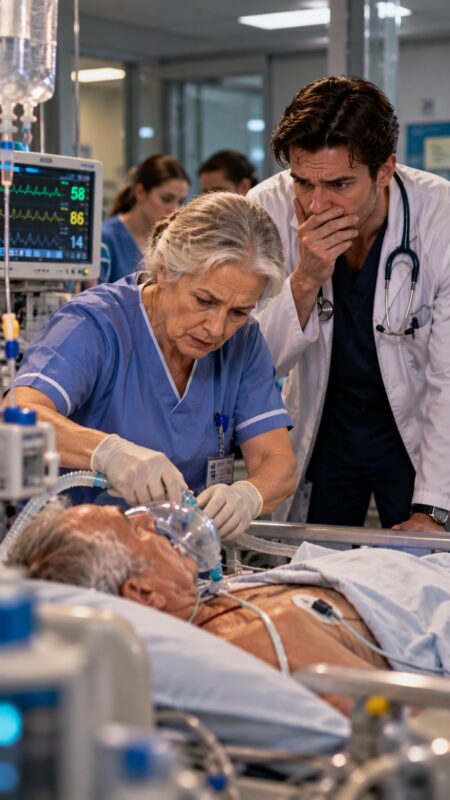
Standing nearby was Margaret, a 62-year-old nurse. She had worked at the hospital for almost forty years and immediately noticed that something was wrong with the patient.
The man was unusually pale, his hands had grown cold, and he was answering questions more and more slowly.
“Doctor, I don’t like the way this patient is doing,” she said quietly. “We need to call a senior doctor urgently.”
Daniel turned toward her irritably.
“Margaret, I studied medicine for six years. You don’t need to teach me how to do my job. Just carry out my orders.”
The nurse said nothing, but she stayed by the patient’s side.
A few minutes later, the man suddenly clutched his abdomen and lost consciousness.
“His blood pressure is dropping!” Margaret shouted.
Daniel rushed to the bed. He stared at the monitor in confusion, trying to understand what was happening.
Margaret had already pressed the emergency button, called the resuscitation team, and begun the necessary procedures.
When the head of the department arrived, she quickly explained all the changes in the patient’s condition.
He listened to her, glanced at the examination results, and turned sharply toward the young doctor.
“Daniel, do you even realize what almost happened here?”
But before Daniel could answer, the department head said something that made him lower his eyes in shame…
The full story is in the first comment 👇

“The patient most likely has internal bleeding!” the department head said. “Margaret noticed the warning signs before he even lost consciousness. Why didn’t you listen to her?”
Daniel remained silent. Just half an hour earlier, he had been certain that he had everything under control. Now he stood beside the bed of a man who could have died because of his arrogance.
“I reviewed the test results, and his blood pressure was normal…” he finally managed to say.
“But did you actually look at the patient?” the department head interrupted. “His condition was changing right in front of your eyes!”
Meanwhile, Margaret was helping the resuscitation team. She remained calm, handed the doctors the instruments they needed, and monitored the readings on the screen.
Soon afterward, the patient was rushed for further examinations. The tests confirmed a dangerous hemorrhage in his abdominal cavity. The man was immediately taken to the operating room.
Daniel remained standing in the empty hospital room.
For the first time, he felt genuinely frightened. Not for his job or his reputation. He could not stop seeing the patient’s face in his mind—the man who had been talking to him only minutes earlier and was now on the brink of death.
Three hours later, the surgeon came out of the operating room.
“We got to him in time. The bleeding has been stopped. He’s in intensive care now, but the prognosis is cautiously optimistic.”
Daniel let out a sigh of relief.
He found Margaret in the nurses’ room. She was sitting at a table, filling out paperwork.
“Margaret, could I speak with you?”
The woman looked up.
“Of course, Doctor.”
Daniel sat down opposite her.
“I wanted to apologize. You warned me, but I wouldn’t even listen. If you hadn’t called for help…”
He fell silent.
Margaret put down her pen.
“Daniel, I’ve been a nurse for forty years. During that time, I’ve seen many young doctors. Some come here to learn, while others come to prove that they already know everything. But do you know what the most frightening thing is?”
“What?”
“When a patient suffers because of someone else’s pride.”
Those words hurt him more than any reprimand could have.
“I won’t make that mistake again,” he said quietly.
Margaret looked at him carefully.
“You’ll make mistakes again. We all do. What matters is that you don’t consider yourself superior to the people working alongside you.”
The following day, the department head summoned Daniel to his office. He was required to review the incident in detail, undergo additional training, and work under the direct supervision of an experienced doctor for a while.
Daniel did not argue. He understood that he deserved the conversation.
A week later, the same patient began to recover. When Daniel came to examine him, the man smiled.
“I was told your nurse saved my life.”
“Yes,” Daniel replied. “If it weren’t for her, things could have ended very differently.”
That evening, just before the end of his shift, Daniel approached Margaret in front of the other staff members.
“I want everyone to know that I made a serious mistake last week. Margaret recognized the danger in time and helped save a patient. I was rude to her when I should have listened. I’m sorry.”
The room fell silent.
Margaret smiled.
“Well, Doctor, are we working the same shift again tomorrow?”
“If you don’t mind,” Daniel replied. “I still have a lot to learn from you.”
From that day on, whenever Margaret said, “Doctor, I’m concerned about this patient’s condition,” Daniel never brushed off her concerns again.
He would go to the bedside, examine the patient carefully, and ask:
“Margaret, what exactly caught your attention?”
Years later, after becoming an experienced doctor himself, he often told younger colleagues about his very first shift.
“A medical degree gives you the right to treat people,” he would say. “But it doesn’t give you the right to believe you’re smarter than everyone else. Sometimes, a single sentence from an experienced nurse can save someone’s life. What matters is knowing how to listen in time.”