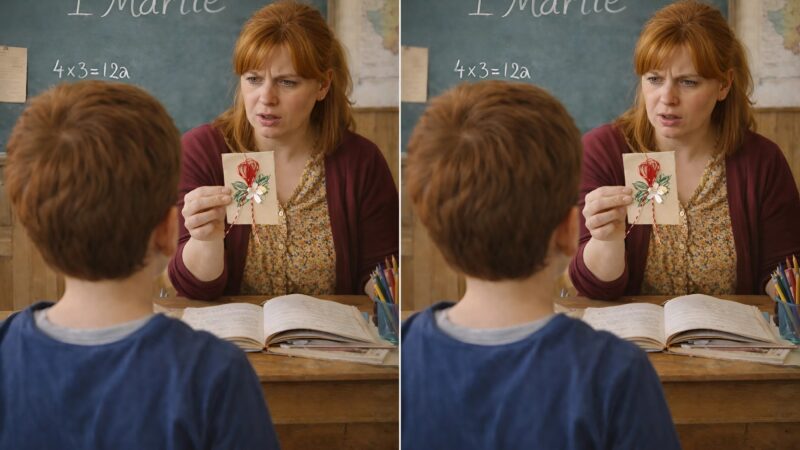
“What kind of gift did you find, Mark? Honestly, wasn’t there anything better?” — the teacher said with a slight smirk, without even looking at the boy or his card.😲😵
The sentence sounded almost playful, but for an eight-year-old child it was a blow. A quiet giggle rolled through the classroom — soft, seemingly without malice, yet clear enough to burn.
Mark stood by his desk with his hand stretched out, clutching a red-and-white string. The smile slowly faded from his face, and a hot flush rose to his cheeks.
— Put it on the table and sit down, — Miss Roberts added dryly, already flipping through the register.
He didn’t put anything down. He carefully slipped the small greeting card for the first day of spring into his pocket and sat down, staring at the scratches on his desk as if he could hide there from the shame.
The evening before, Mark had sat in the kitchen for a long time. He cut up an old cookie box, unraveled threads from his mother’s supplies, unevenly cut out a flower, and carefully glued it on, wiping the glue off with his sleeve.
He had heard his mother whispering on the phone about bills and debts, and he decided not to ask for money. He wanted to make a gift himself — for his classmates and for the teacher.
When my Mark returned from school, he didn’t immediately admit why he was crying. He turned away and pretended to be tired.
Then he silently took the slightly crumpled gift out of his pocket and whispered, “Mom, she said it was ugly…” At that moment my heart tightened, as if someone had told me that I hadn’t tried hard enough.
The next day I came to school. Calm on the outside, but with a firmness I hadn’t expected from myself.
🙁😨I didn’t raise my voice, because it wasn’t a shout that was needed. Every word had to be heard. And when I began to speak, the classroom became so quiet that you could hear someone awkwardly moving a chair.
Continuation in the first comment.👇👇
I looked at the children — they were no longer smiling. Then at the teacher.
— You saw uneven cardboard, — I said calmly. — I see two sleepless nights. You noticed a crooked flower. I see a child who decided not to ask his mother for money because he heard her worrying about the bills.
I wasn’t accusing. I was explaining. But every word was a truth that could not be brushed aside.
— He wasn’t crying because of the teasing, — I added more quietly. — He was crying because he believed that his efforts meant nothing.
Tears stood in Mark’s eyes, but he did not lower his head. For the first time in those days, he was looking straight ahead.
The teacher was silent for a long time. Then she took his gift in her hands — differently now, carefully, as if she were afraid of damaging not the cardboard, but something more fragile.

The next day, in front of the entire class, she said that she had been wrong. That the most valuable gift is the one into which a heart has been put. The children listened attentively, without giggles.
And that evening my son came home calm. He no longer hid his eyes or squeezed the pocket of his coat. He simply said:
— Mom, she put it on the table.
Sometimes adults need the courage of a child to remember why they chose their profession. Sometimes a mother has to become the voice when her son’s is taken away.
And if this story teaches anything, it teaches only one thing: a teacher’s word can wound deeper than mockery. But that same word can heal — if it carries respect.