“Hey, old man… raise your head when Rome speaks to you!” — the soldiers mocked and humiliated the beggar with loud laughter until he slowly pulled back his hood… And in that very instant, their faces turned pale: moments later, the legionaries were already kneeling before him, their voices trembling as they begged for forgiveness… 😳
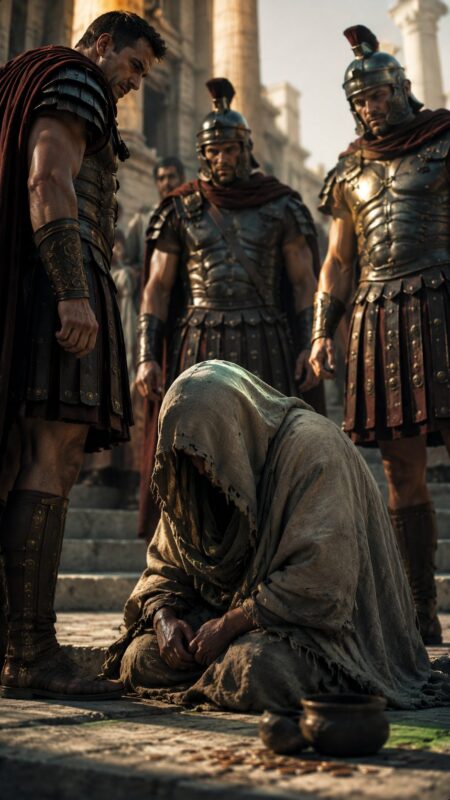
Coins scattered across the stone steps with a sharp clatter at the exact moment a Roman soldier, smirking, kicked the beggar’s wooden bowl with his foot.
Several onlookers above burst into loud laughter, while a second legionary deliberately stepped on one of the coins with his sandal, as though savoring the humiliation.
The old man in a torn gray cloak did not even try to pick up the money. He sat motionless, hunched beneath his hood, gripping the cloth over his knees tighter with trembling fingers.
— Look at him… — one of the soldiers scoffed. — Seems this little rat thinks he deserves the Emperor’s mercy.
Another leaned closer and jerked him sharply by the shoulder.
— Hey, old man, raise your head when Rome speaks to you!
The crowd around them stirred. Some laughed, some looked away awkwardly. Only a young scribe by the column watched the beggar with concern, as though sensing something was terribly wrong.
The soldier suddenly grabbed the bowl and dumped the remaining coins directly into the dust.
— Crawl after them like a dog.
For several seconds, a strange silence hung in the air. The old man slowly inhaled and then, for the first time, raised his hands to his hood.
The fabric slowly slipped back.
And in that very instant, the smug smiles vanished from the soldiers’ faces: one suddenly turned deathly pale, the other recoiled as though he had seen a ghost.
Then all three collapsed to their knees before the beggar at the same time… 😳
Continuation in the first comment.👇👇

No one in the square understood why the Roman legionaries had suddenly bowed their heads before a filthy beggar. The crowd began whispering, people rose from their seats, and the young scribe involuntarily stepped forward.
Beneath the hood appeared the face of a man whom all of Rome had believed dead for nearly twenty years.
Stretching across his right cheek was an old crescent-shaped scar — the mark of General Aurelius Varron, a legendary commander and the Emperor’s closest friend. It was he who had once saved the capital during an uprising before vanishing without a trace after a betrayal in the Senate.
The older soldier lowered his gaze to the ground.
— That’s impossible… We saw your funeral pyre…
The old man looked at him wearily. His eyes were not filled with anger but emptiness, as though everything human inside them had long since burned away.
— The pyre was needed by those who feared the truth, — he replied quietly.
Several years earlier, Varron had discovered that senators were selling orphans from poor provinces into slavery. When he tried to stop it, he was declared a traitor. His name was erased from the chronicles, and he was left to die far beyond Rome.
He survived. But he did not want to return.
Until a week ago, when he saw an orphaned boy on the street with the same look of fear he had once seen in soldiers after the war.
The Emperor slowly descended the steps and stopped before the old man.
Absolute silence filled the square.
— Forgive me, old friend… — he whispered, barely audible.
Varron remained silent for a long time and then, for the first time in many years, extended his hand to the man he had once trusted more than his own life.